
Book an instant secure install →
The fastest path to real gains in ecommerce CRM this year is a self-hosted, open-source agent framework with pro setup. For AI-powered CRM and business tool integration, that approach delivers speed-to-value and control without enterprise price tags.
You want results in weeks, not quarters. A lean stack that unifies store, ads, and support data will lift repeat rate and slash ticket time. According to GlobussoftAI data, businesses implementing AI services report up to a 40% reduction in operational costs and 30% increase in productivity. In 2026, the math is simple: if the platform pays for itself under $10/month in infra and reduces manual work, you bank margin.
GlobussoftAI OpenClaw fits that brief with an open-source AI agent framework, pro deployment, and ecommerce-ready automation. It runs on your server, plugs into your CRM and analytics, and drives actions over WhatsApp, Telegram, and email. You keep control of data and costs while moving fast.
For a deeper look at OpenClaw’s deployment features and examples, see the in-depth page on OpenClaw AI integration. If you are comparing approaches more broadly, this primer on AI integration explains the stages from audit to rollout in plain terms.
Why Ecommerce Brands Struggle with CRM Integration
Your store stack has grown fast. Shopify or WooCommerce holds orders and product data. Your CRM tracks touchpoints. Ad platforms push audiences.
Helpdesk logs tickets. However, these systems rarely sync cleanly in real time. As a result, your team sees fragments, not the full customer story.
Manual segmentation breaks down first. For example, “high-LTV” lists often lag by days because someone exports, merges, and uploads files. Therefore, browse and cart signals go stale before a campaign hits the inbox. Moreover, support has no clue a user just spent $300, so they miss a chance to upsell or fast-track a VIP.
Disjointed tools also waste money. Specifically, ad platforms keep spending on lapsed buyers because suppression is late. In addition, email flows send generic offers that ignore new category intent. As a result, your CAC rises while LTV stalls. You feel the drag every peak season when teams scramble with spreadsheets.
Technical bottlenecks
The tech details make it worse. On the one hand, webhooks fire in bursts and fail silently. On the other hand, CRMs throttle API calls under load. Without a smart, fault-tolerant hub that unifies data and orchestrates actions, you leak revenue across touchpoints. You also burn hours on fixes that never stick.
- Cart and browse events fail to enrich CRM profiles within minutes.
- Support bots lack order context, so they escalate simple issues.
- Lifecycle flows fire late, missing the 24–48 hour purchase window.
- Bulk uploads and manual tags create errors that skew analytics.
In short, you don’t need more tools, you need tight, AI-powered CRM and business tool integration that treats every signal as a trigger and every channel as an action surface.
What to Look for in an AI CRM Integration Service for Ecommerce
Start with data unification across channels. Your service should pull store events, ad audiences, email metrics, and support tickets into one model within minutes. Furthermore, it should resolve identities across email, phone, and device with clear rules. This is the backbone for clean LTV, cohort, and attribution views you can act on the same day.
Next, demand predictive analytics built for CLV and demand forecasting. You want models that flag next best product, churn risk, and purchase window. Moreover, the platform should expose these scores to your CRM segments and automation tools, not lock them away. Clear lift tests and readable reports also matter, so you can tie models to margin.
Third, ensure NLP-powered support integration. Specifically, chatbots should read order state, shipping ETA, and policy rules to answer complex questions and route exceptions. They should also log every step back to the CRM, so profiles stay fresh. Ideally, you can run support flows across WhatsApp, email, and web chat from one brain.
Security, scale, and cost
Security is not optional. Insist on end-to-end encryption and role-based access controls for security. Ask for audit logs and environment hardening details. For added confidence, match practices to ISO/IEC 27001 controls. Self-hosting reduces exposure by keeping PII inside your infra, which is key for ecommerce.
Scalability must be proven, not promised. Therefore, look for concurrent session handling, queue back-pressure, and failure injection tests. In addition, ask how they plan capacity for Q4. Scalability planning for long-term growth saves you from last-minute throttling or downtime during promotions.
Finally, push for cost transparency. You should see the line items: core framework, hosting, model usage, and pro services. For example, a free core framework with a $5/month VPS and total costs under $10/month with AI model usage sets a clear floor. Anything that hides usage or locks you into a vendor-only model will hurt margins.
Buying criteria checklist
- Multi-channel data unification with identity resolution
- Predictive CLV and churn scores exposed to CRM segments
- NLP support that reads order and ticket context
- End-to-end encryption, RBAC, and audit logs
- Proven load tests and seasonal scale plans
- Clear pricing: infra, models, and services separated
Keep these six points front and center. With them, you will assess AI-powered CRM and business tool integration proposals on real outcomes, not slideware.
Also Read!
How to Integrate AI with Your Healthcare CRM: A Step-by-Step Guide
How GlobussoftAI OpenClaw Solves CRM Integration for Ecommerce
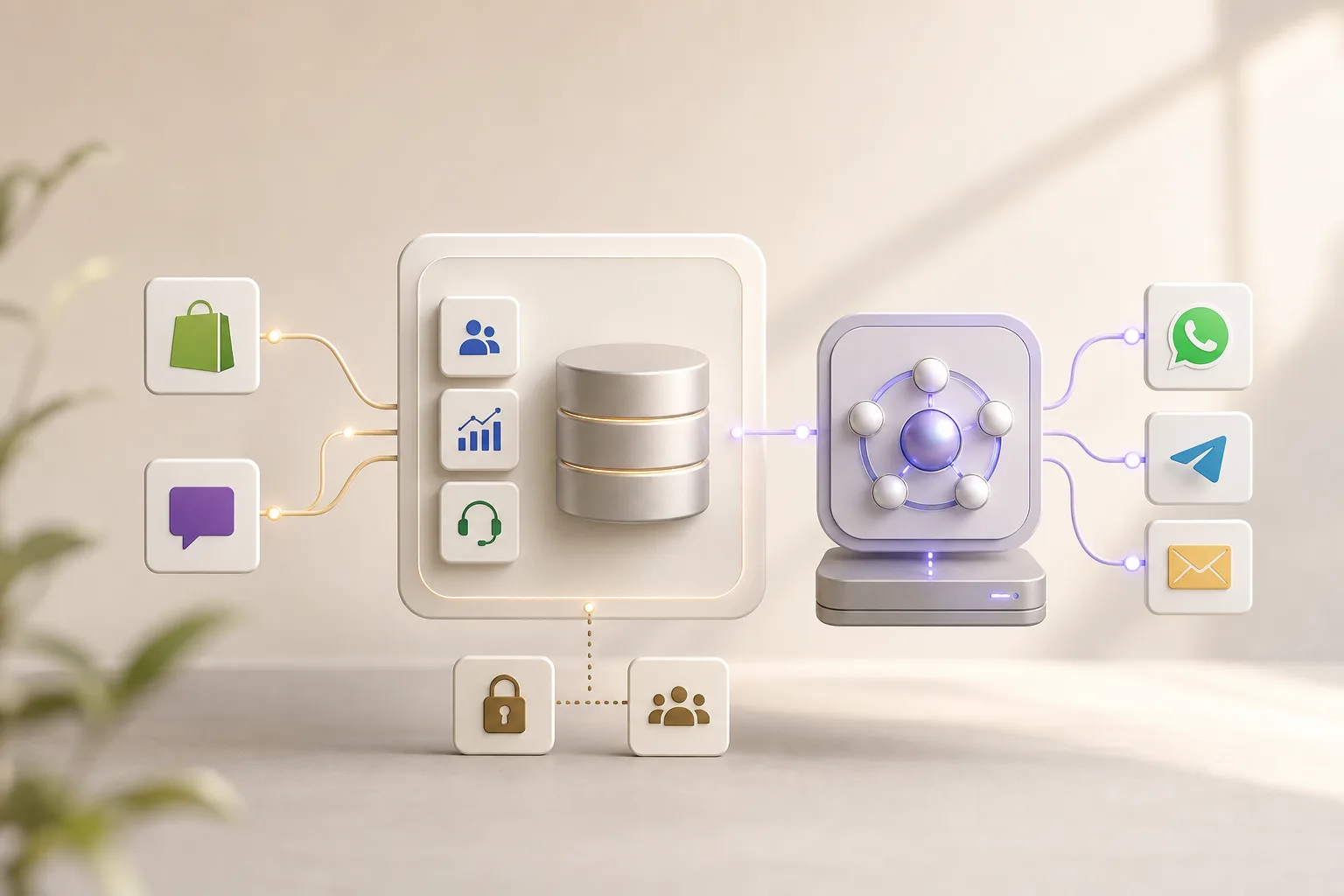
OpenClaw is an open-source AI agent framework that runs autonomous workflows on a self-hosted server. It connects your CRM and analytics stack, then turns real-time store signals into actions over WhatsApp, Telegram, and email. As a result, your brand moves from “reactive” to “event-driven” without waiting on vendor roadmaps.
First, system integration with CRMs and analytics tools pulls orders, events, and segments into a shared layer. Profiles update as customers browse, buy, or contact support. Because the core is agent-driven, workflows react within minutes, not days. Moreover, identity resolution and enrichment keep profiles clean for targeting and service.
Second, predictive analytics platforms in OpenClaw score CLV, churn risk, and next best product. These scores feed your lifecycle flows right inside the CRM. Therefore, you send fewer, sharper messages that match current intent. Over time, your report shows lift by cohort, so you can tune offers with less guesswork.
Orchestration and channels
Third, chatbots powered by Large Language Models handle complex queries with human-like responses. They read live order state to answer “Where is my package?” and cross-check policy to resolve returns. When needed, they escalate with summaries that save your agents time. In turn, first response time falls while CSAT rises.
Fourth, Multi-Agent Orchestration breaks big tasks, like “recover this cart and send a size guide”, into smaller steps across systems. One agent pulls the cart, another drafts the message, a third checks send windows, and a fourth logs the result. This design improves fault tolerance and makes each piece testable and fast.
Fifth, instructions execution through WhatsApp, Telegram, and email gives you reach where your shoppers hang out. For example, you can send a WhatsApp reminder two hours after a cart event, then follow up by email with a tailored size chart. You can even set a plain English cron job to run a daily check on VIP open tickets.
In practice, the gains compound. Businesses implementing AI services report up to a 40% reduction in operational costs and 30% increase in productivity (GlobussoftAI data). Because the core framework is free and a typical VPS costs around $5/month, total costs are usually under $10/month with AI model usage. In addition, over 1,000 hours of testing data was used to explore OpenClaw’s features and harden the workflows.
“We replaced three manual handoffs with one OpenClaw workflow and cut ticket backlogs by the weekend. The WhatsApp summaries are gold.” — Ecommerce Ops Lead
For install guidance, the dedicated overview on OpenClaw AI integration covers setup, security, and examples. If you prefer a broader playbook, the Best AI CRM Integration Service for Small Businesses in 2026 guide shows how lean teams launch fast.
Get instant AI orchestration →
Visualizing the OpenClaw workflow

By mapping each buying criterion to a concrete feature, system integration, predictive analytics, NLP support, multi-agent design, and multi-channel actions. OpenClaw delivers AI-powered CRM and business tool integration built for speed and control.
GlobussoftAI vs. Generic CRM AI Plugins: An Honest Comparison
Native CRM AI tools such as Salesforce Einstein or HubSpot AI are convenient. They live inside one vendor, ship prebuilt templates, and need little setup. For simple use cases, that’s a fine start. However, they bind you to one ecosystem. As soon as you need cross-channel actions or self-hosted control, you hit a wall or high add-on fees.
GlobussoftAI OpenClaw takes a different path. It is an open-source AI agent framework that runs autonomous workflows on your server. You choose models and channels, and your data stays in your stack. Because the core framework is free, paired with a typical $5/month VPS, most teams keep infra under $10/month including AI model usage. That flexibility is hard to match inside a closed CRM plugin.
Where do generic tools excel? They shine at quick wins inside their own UI. For example, scoring a lead or drafting a simple email from a contact view is smooth. If your store is already “all-in” on one CRM and you rarely touch WhatsApp or Telegram, staying native may be fine.
Where does OpenClaw pull ahead? It orchestrates ecommerce-specific workflows end-to-end. It listens to store webhooks, updates the CRM, scores CLV, answers support with order context, and triggers WhatsApp or email, then logs the result for reporting. It also scales horizontally for peak traffic, with failure injection tests to prove it.
| Dimension | GlobussoftAI OpenClaw | Native CRM AI Plugins |
|---|---|---|
| Hosting & Control | Self-hosted; full data control | Vendor-hosted; limited control |
| Flexibility | Multi-channel (WhatsApp/Telegram/email) and multi-agent | Mostly inside one CRM UI |
| Cost | Free core; VPS ~$5/month; under $10/month total typical | License tiers and add-ons |
| Ecommerce Workflows | Built for orders, carts, CLV, support context | Generic lead/contact actions |
| Scale & Testing | Handles high-volume loads; failure injection | Dependent on vendor limits |
 and native CRM AI plugins)
Community traction also matters. OpenClaw reached 100,000 GitHub stars in under eight weeks, which shows strong developer interest and rapid iteration. Compared to alternatives, that momentum plus self-hosting makes OpenClaw a strong pick for AI-powered CRM and business tool integration at scale.
Trust, Security, and Proven Performance
Security comes first. OpenClaw deployments include end-to-end encryption and role-based access controls for security. Credentials sit in hardened stores, and each action is scoped to the minimum needed role. A security-focused setup including access control and encrypted communication is part of the standard install.
Performance is proven through testing, not claims. Over 1,000 hours of testing data was used to explore OpenClaw’s features and harden common ecommerce flows. That includes environmental parity for consistent test results and run-comparison tooling to create benchmarks you can rerun. Therefore, you know what will happen under load before you launch a campaign.
Scale is about real stress, not lab demos. OpenClaw shows the ability to handle high-volume loads, concurrent sessions, and failure injection scenarios. For peak season plans, you get clear guidance on horizontal scale, queue sizing, and circuit-breaker rules. As a result, your BFCM plan rests on data, not hope.
For governance, you can align practices with common standards such as ISO/IEC 27001 controls. While certifications live at the org level, the features, encryption, RBAC, audit logs, map cleanly. In addition, self-hosting means PII never leaves your infra, which reduces vendor risk and keeps your legal team calm.
- End-to-end encryption with role-based access controls
- Proven high-volume, concurrent load handling
- Failure injection and benchmark comparisons for reliability
- Performance optimization to ensure process efficiency
If you need managed operations, GlobussoftAI offers ongoing support. This includes updates, new workflows, and model tuning tied to your KPIs. With that, you get both security and speed, backed by social proof from the open-source community.
Also Read!
Can Healthcare Organizations Trust AI-Powered CRM Integration?
Getting Started: Integrating AI into Your Ecommerce CRM Stack
You can launch in four steps. Each step keeps risk low and impact high. The result is a working CRM+AI stack in weeks, with clear costs and a plan for 2026 promotions.
Four-step rollout
Step 1: Audit your current CRM and data flows. Map store webhooks, CRM objects, support queues, and ad audiences. Identify the biggest leaks: abandoned cart timing, stale segments, or slow VIP support.
Step 2: Define automation priorities. Choose the 2–3 highest-impact workflows: abandoned cart recovery, predictive segmentation for cross-sell, and NLP support with order awareness. Set clear success metrics, recovered revenue, CSAT, or ticket deflection.
Step 3: Deploy OpenClaw with professional deployment and installation. Run it on a self-hosted VPS (about $5/month). With the free core framework, total costs are usually under $10/month with AI model usage. Add a security-focused setup, including access control and encrypted communication. Tie in your CRM and analytics tools.
Step 4: Iterate with AI-driven reporting. Use custom development for workflow automation and AI-driven reporting. Add AI/ML consulting to build roadmaps and implement solutions as new signals emerge. Expand channels to WhatsApp and email, then layer in proactive context-based reminders.
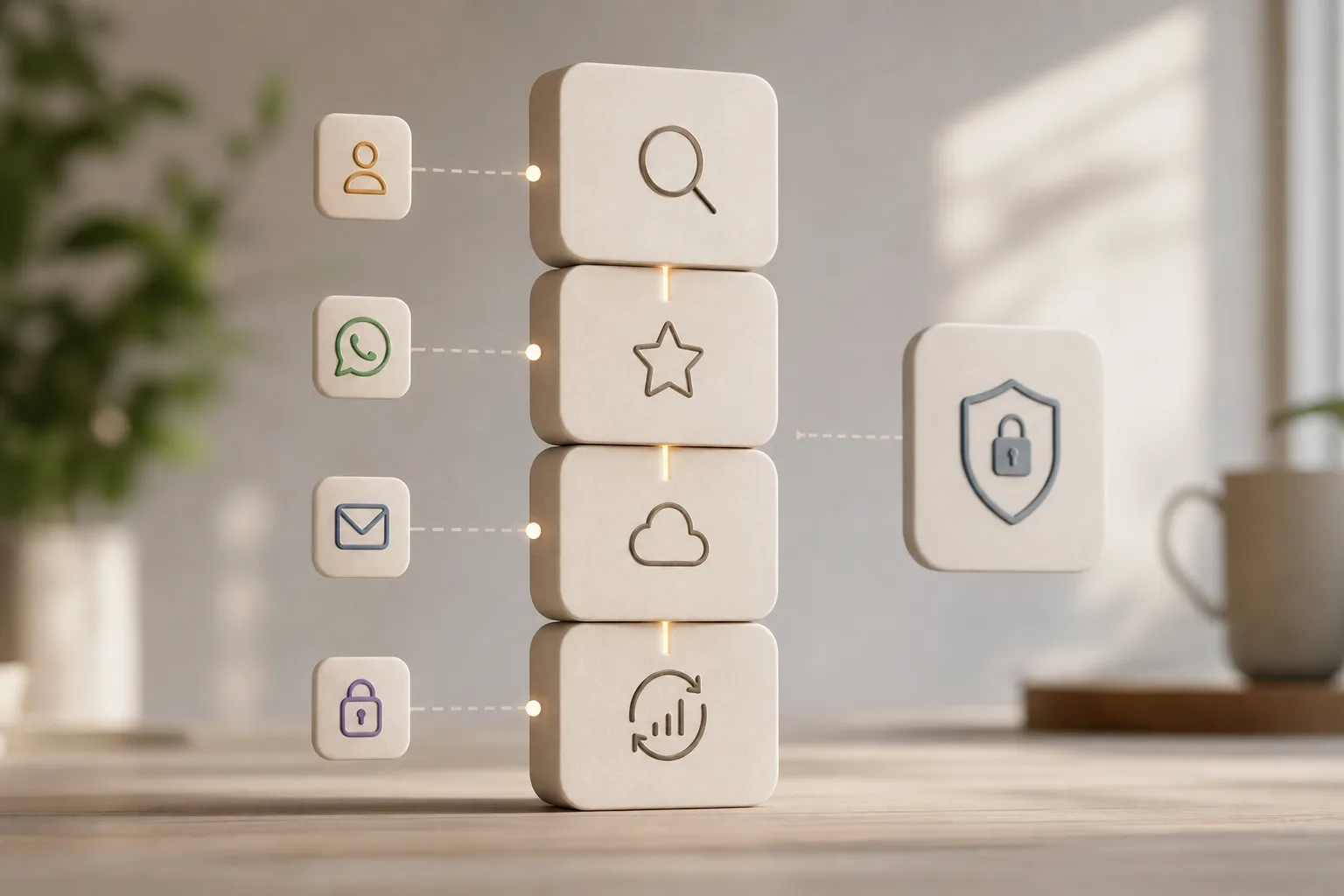
For teams that want a lean starting point and practical examples, this expanded AI powered CRM and business tool integration 2026 guide 2 breaks down workflows and tests you can copy. It pairs well with the broader generative ai for business overview if you plan to add more agents later.
Start your first workflow today →
Frequently Asked Questions

How much does AI CRM integration for ecommerce typically cost?
OpenClaw’s core framework is free. VPS hosting runs about $5/month, and total costs are usually under $10/month with AI model usage. Professional deployment and custom development are quoted separately based on scope. This model keeps fixed costs low while you scale workflows that prove ROI.
Can this integrate with Shopify, WooCommerce, or BigCommerce?
Yes. OpenClaw’s smooth integration services connect AI into existing ecommerce platforms and CRMs. Custom development adapts workflows to your specific platform stack and naming. As a result, you keep your current tools while adding event-driven automation. You also gain a shared profile layer that updates in near real time.
How does this compare to Salesforce Einstein or HubSpot AI for ecommerce?
Native CRM AI tools are convenient but locked to one ecosystem. OpenClaw is open-source, self-hosted, and platform-agnostic, giving ecommerce brands flexibility across multiple CRMs and channels. If you need WhatsApp actions, Telegram commands, or self-hosted data control, OpenClaw offers more room to grow. If you live inside one CRM and need only light AI help, a native tool may suffice.
Is my customer data secure with a self-hosted AI integration?
OpenClaw uses end-to-end encryption and role-based access controls. Self-hosting means customer data never leaves your infrastructure, which is critical for ecommerce PII compliance. You also get audit trails and environment hardening as part of deployment. In short, you gain control without giving up speed.
Can AI CRM integration handle Black Friday-level traffic spikes?
Yes. OpenClaw has the ability to handle high-volume loads, concurrent sessions, and failure injection scenarios. Scalability planning is built into deployment to handle seasonal ecommerce peaks. You also receive guidance on queue sizing and back-pressure so flows keep running when traffic surges.
What ecommerce workflows can be automated with AI CRM integration?
Abandoned cart recovery, customer segmentation, predictive CLV scoring, and support chatbots via WhatsApp and email are all supported. You can also run proactive context-based reminders, like size guides after a fit-related ticket. Over time, you can add cross-sell flows and VIP alerts as you see lift.
How long does it take to deploy AI CRM integration for an ecommerce store?
Professional deployment includes installation, integration, and optimization. Timeline depends on complexity, but the consulting-first approach builds a roadmap before touching code. Most stores can ship a first workflow within weeks, then expand with AI-driven reporting and testing.
Do I need a technical team to maintain this after setup?
GlobussoftAI offers managed AI operations and ongoing optimization. Plain English cron job setup and WhatsApp-based controls mean non-technical users can trigger workflows daily. Your team can also request changes in clear language, while engineers handle versioning and tests under the hood.
Final Takeaways
- Self-hosted, open-source agents give you control, speed, and costs under $10/month for infra plus models. That changes your 2026 margin math.
- OpenClaw maps cleanly to key buying criteria: unified data, predictive CLV, NLP support, encryption with RBAC, seasonal scale, and transparent pricing.
- Compared to native CRM AI, OpenClaw wins on flexibility, self-hosting, and ecommerce-first workflows, with proof from 100,000 GitHub stars and over 1,000 hours of testing.